
Guardsman Air Duct Cleaning in Elmwood Village: A Homeowner’s Guide
Guardsman air duct cleaning in Elmwood Village usually means a licensed local contractor running Guardsman-style negative-pressure equipment, not a factory crew sent by the brand. The system pulls your ductwork under vacuum while rotary tools agitate the walls, and the single number that decides whether it works is the pressure it holds, measured in inches of water column. Most quotes you’ll get around here never mention that spec. If you’d rather not sort through the fine print yourself, call (855) 726-7901.
What does “Guardsman” actually mean for air duct cleaning in Elmwood Village?
In most cases, a Guardsman duct cleaning in Elmwood Village is performed by an independent, licensed contractor who uses Guardsman-approved equipment and holds a service agreement with the brand. The company renting a unit and the company that owns one can look identical on a quote sheet. Homeowners assume the name on the invoice is the name on the machine. It often isn’t.
Here’s what the Guardsman name signals to a commercial facilities manager, and why it carries weight:
- Negative-pressure extraction: the machine seals the system and pulls the whole duct run under vacuum before any brush touches a wall.
- Truck-mounted power: the vacuum source lives on the vehicle, not in a portable canister, which means sustained airflow instead of a fading pull.
- HEPA-stage filtration: exhaust air passes through filters so dislodged debris doesn’t blow back into the living space.
Commercial contractors have relied on that setup for years because it handles long, wide duct runs in offices and restaurants. Residential systems in Elmwood Village are a different animal: shorter runs, tighter plenums, and supply branches that often narrow to six or eight inches. The equipment still works, but only if the operator understands those dimensions and adjusts airflow accordingly. That’s the first thing to ask about.
How does negative pressure actually remove debris from your ducts?
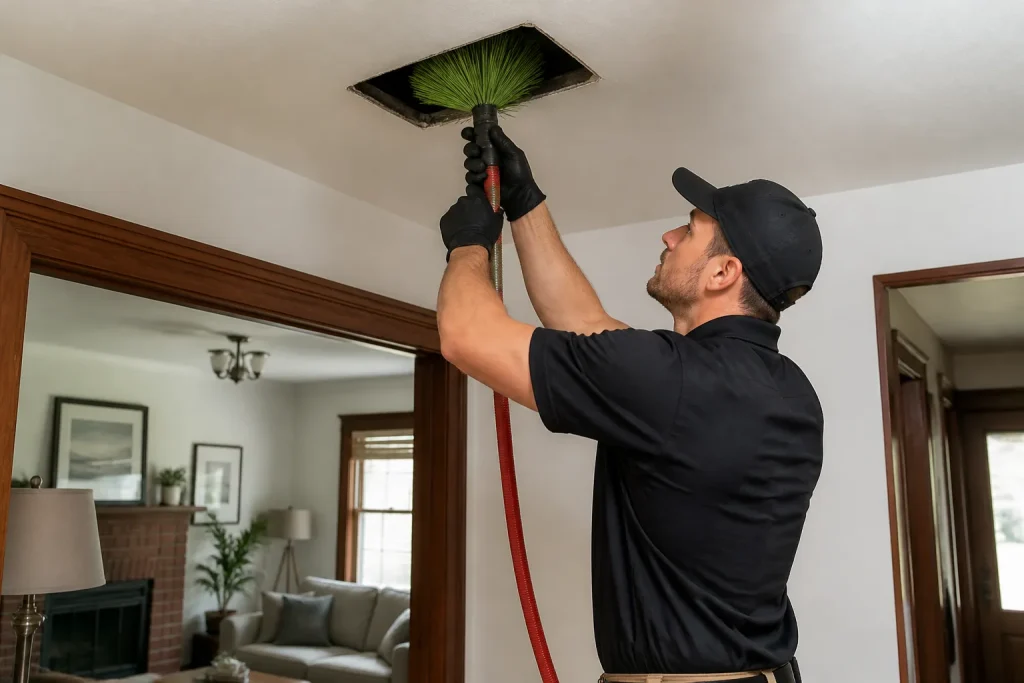
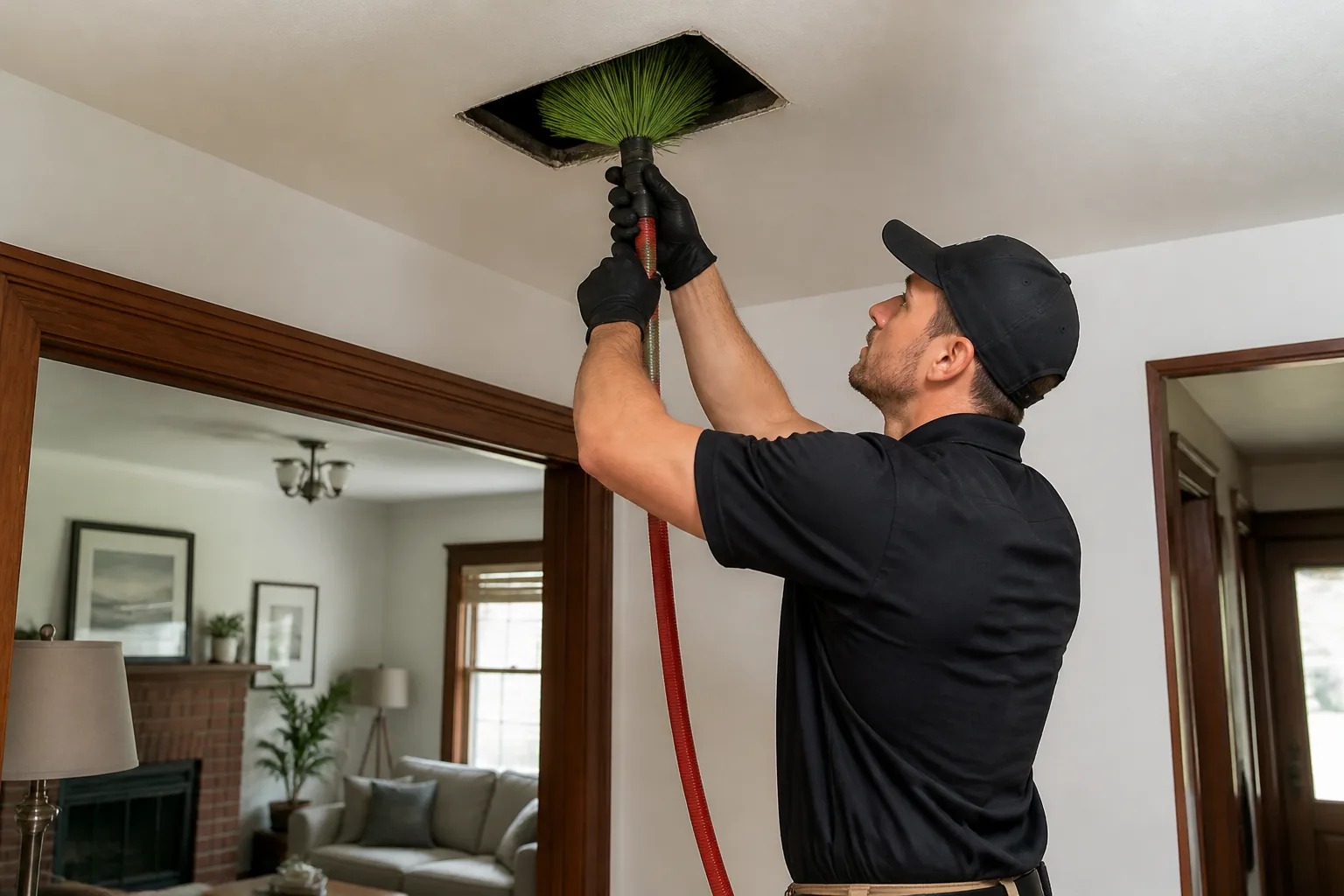
Negative pressure is the whole mechanism. Before cleaning starts, the technician seals the supply and return openings and hooks the vacuum line into the main trunk. Once the system is under vacuum, air rushes inward from every register rather than outward into your rooms. Debris that gets knocked loose has only one place to go.
The pressure is measured in inches of water column. A properly contained job holds a steady vacuum throughout, which is why the technician should be watching a gauge, not just listening for suction. Weak or fluctuating pressure is the tell that a connection has slipped or the machine is undersized for the duct run. In our experience, most service complaints about “dust coming back out of the vents” trace back to a pressure problem nobody checked.
Airflow rating matters too. A truck-mount rated for commercial ductwork moves far more air than the residential branch lines it’s feeding. On larger Elmwood Village homes with long trunk runs, that extra capacity keeps extraction steady. On smaller systems, the tech has to modulate it or the vacuum overpowers the flex connections. Ask what airflow rating the machine has and whether it’s been dialed down for your home’s duct diameters. A crew that can answer that in plain terms has done the job before.
How do you verify a contractor actually owns Guardsman equipment?
You ask, and then you ask for proof. Any contractor claiming Guardsman capability should be able to show you the equipment on arrival and walk you through the setup before work begins. Here’s a simple check you can run in five minutes on the phone:
- Ask for the model name and number of the vacuum unit they plan to bring. Vague answers (“we use industry-standard equipment”) are a pass.
- Ask for their contractor or affiliate status with the manufacturer, and who to verify it with.
- Ask what happens to the exhaust air. If the answer doesn’t mention filters or HEPA stages, the containment is incomplete.
- Ask whether the same crew performs the full job or whether a subcontracted team arrives on the day.
None of this is hostile. Experienced technicians expect the question and usually enjoy explaining the machinery. The contractors who dodge it are the ones to walk away from. Our own approach is to name the brand on the machine before we’re asked, because that’s the difference between a rental setup and professional-grade equipment, and homeowners deserve to know which they’re paying for.
What Guardsman cleaning does not cover (and why homeowners assume it does)
A Guardsman duct cleaning removes loose debris from the inside of ductwork. That’s the mechanical scope, and it’s genuinely useful. It does not reseal leaky joints, sanitize biological growth, or repair crushed flex duct. Those are separate jobs, sometimes separate trades, and a quote that bundles them without saying so is worth questioning.
Walk through any of the older homes near the Elmwood Strip and you’ll find a duct system that’s been patched more than once. Flexible branch lines that sag or kink at the plenum, seam joints where tape has dried out, and attic or basement runs that were never properly supported. Cleaning removes the dust; it doesn’t fix the reasons that dust keeps moving through the house. The most common gaps we tell homeowners to budget for separately:
- Duct joint sealing: mastic or foil tape on leaks in the trunk and branch connections, not something a cleaning machine does.
- Sanitizing: residual mold spores, bacteria, and odors need a treatment applied after debris removal, using a product like our Guardsman-grade sanitizing line or an Aprilaire air quality solution for longer-term control.
- Flex duct repair: crushed or torn sections need replacing, not just cleaning.
A single call that covers cleaning, sealing, and sanitizing closes the loop. If your contractor only does the cleaning, plan for the rest with a separate provider.
Why the inspection step matters more in an Elmwood Village home
Elmwood Village homes were built across a wide span of decades, and the ductwork in them rarely looks textbook. Some properties have been rewired, re-plumbed, and re-ducted at different points, so the supply and return layout can look nothing like the original drawings. Before any Guardsman service begins, the technician should map what’s actually there: trunk size, branch diameters, how many turns each run takes, where the plenum sits relative to the air handler.
That inspection prevents two common problems. First, an undersized branch line gets blamed for poor airflow when the real issue is a kinked flex connection at the plenum. Second, a technician working blind may over-extend a rotary tool into a section of duct that’s already sagging, worsening a leak they never saw. A proper inspection takes twenty to thirty minutes and saves hours.
We treat the inspection as the first step of every job, whether the cleaning itself uses a truck-mount or a portable rotary system. The pattern of how a home’s ducts got reconfigured over the years is what we’re reading, not just the register count. That’s also the point where we flag whether the cleaning alone solves the problem or if duct repair and sealing need to be part of the same visit.
What a completed Guardsman job should look like
You shouldn’t need to take anyone’s word for it. A finished job leaves physical signs you can check before paying, and the technician should be willing to walk the house with you as the last step.
- At each register: no loose dust visible inside the boot, and the grille wiped clean. Cover plates reinstalled and sitting flush.
- At the air handler cabinet: accessible because the tech opened it to clean the blower and coil housing. The door should be back on with screws, not tape.
- At the return: no debris buildup left in the filter frame or the return boot.
- In the materials: a before-and-after photo set of your own duct interiors, not stock images. This is the most useful proof a contractor can hand you.
Negative-pressure containment should have kept dust off your furniture and floors throughout. If there’s a fine film across the nearest room, the seals weren’t tight enough. Run through that checklist before the invoice is settled. Anything you flag should be addressed on the spot.
When to call a pro: if you’re seeing consistent dust buildup on registers, musty odors from the return, or a family member whose allergies worsen when the heat or AC runs, it’s time for an inspection. The same applies if your dryer vent cleaning hasn’t been done in years, since a clogged vent is a fire risk that cleaning catches before it becomes one.
Related services in Elmwood Village: beyond cleaning, we handle HVAC cleaning and duct repair when the inspection turns up leaks or damaged flex.
The Bottom Line
Guardsman is a name worth asking about, but the name alone doesn’t clean your ducts. What does is negative-pressure extraction held at the right vacuum, a technician who knows your duct dimensions, an inspection that precedes any brush, and a scope of work that’s honest about what cleaning doesn’t cover. Check the contractor, not just the label. If you’re in Elmwood Village and need help, Air Duct Cleaning Elmwood Village offers free estimates, one flat price per system agreed before work starts, before-and-after photos of your own ducts, and a satisfaction guarantee. Call (855) 726-7901. We answer 24/7. Fast dispatch from 7am to 7pm, Sunday through Friday. Our technicians have up to 10 years of experience, and every job runs with professional-grade equipment, from air duct cleaning through sanitizing.
Frequently Asked Questions
Most whole-home duct cleanings fall in the range you’d expect for a contained, negative-pressure job, and the exact figure depends on your system size, duct layout, and whether repair or sanitizing is included. Any quote you get should be a single flat price per system, not a per-vent charge that climbs once the tech is in your basement. Call (855) 726-7901 for an exact quote. Estimates are free.
Usually because the equipment is portable rather than truck-mounted, the containment is partial, or the scope quietly excludes the air handler and blower. A lowball number that turns into a much larger invoice once the technician is on site is the classic bait-and-switch. Ask what machine is coming, whether the air handler is included, and whether the price is fixed before work starts. Call (855) 726-7901 for a straight quote.
Look at the registers, the air handler cabinet, and your return boot, and ask for before-and-after photos of your own duct interiors. A professional crew expects the request. If the photo set looks generic or the air handler door was never opened, the job is incomplete. Call (855) 726-7901 with questions before you book.
Most homes land somewhere between every three and five years, and homes with pets, recent renovations, or allergy-sensitive occupants may need it sooner. Western New York’s humid summers and long heating season mean the system runs heavily on both cycles, so dust accumulates steadily. If you notice musty odors or visible buildup on the registers, don’t wait for the calendar. Call (855) 726-7901 for a free estimate.
Written by the team at Air Duct Cleaning Elmwood Village.
Need Air Duct Cleaning Help?
Call Air Duct Cleaning Elmwood Village - the local pro we connect you with is licensed and insured, with free written estimates in Elmwood Village.
(855) 726-7901